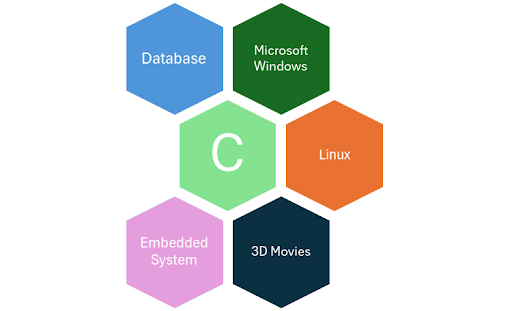
C is a procedural programming language known for its low-level access, efficiency, and portability. It’s based on functions and procedures, allowing direct interaction with hardware, making it suitable for systems programming. C also offers a simple syntax with core concepts like variables, data types, control structures, functions, pointers, arrays, strings, structures, and file I/O.
Key Features of C:
- Procedural Language:C is a procedural language, meaning it’s built around functions and procedures that execute in a specific order to solve a problem.
- Low-Level Access:C provides low-level access to memory and hardware, making it ideal for tasks like operating system development and embedded systems.
- Efficiency and Speed:C programs are known for their efficiency and speed, with minimal runtime overhead.
- Portability:C code can be compiled and run on various platforms with minimal or no modification, thanks to its portability feature.
Basic Syntax Example:
C
#include <stdio.h>

int main() {
    printf("Hello, World!\n");
    return 0;
}
Core Concepts in C:
- Variables and Data Types:C supports various data types like
int,float,char, etc., for storing different kinds of data. - Control Structures:C includes control structures like
if,else,switch,for,while, anddo-whileloops for controlling the flow of execution. - Functions:C utilizes functions to modularize code, breaking down complex problems into smaller, manageable parts.
- Pointers:Pointers in C allow direct memory manipulation, enabling efficient memory management and data access.
- Arrays and Strings:C supports arrays for storing collections of similar data types and strings for storing sequences of characters.
- Structures (struct):Structures allow grouping related data items of different types under a single name, creating custom data types.